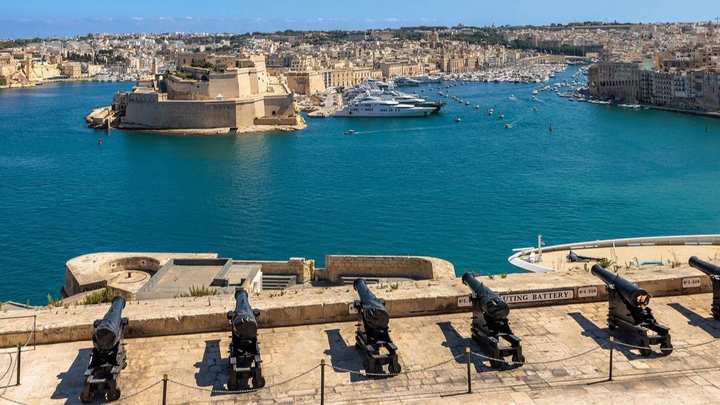
Why Malta
Malta is the only EU country where English is an official language alongside the local one. The Nomad Residence Permit (since 2021) gives non-EU remote workers up to 4 total years of legal residence. The Mediterranean climate is the best on the continent: 300+ days of sunshine, no real winter, no real heat-wave summer (the surrounding sea moderates everything). And the new 10% income-tax option on qualifying foreign-source income for nomads is unique in Western Europe.
Who it suits. The remote worker who wants Schengen access with English as the working language: no need to learn a new local language. The freelancer or consultant attracted to the 10% Nomad Residence flat-tax option. People who want a year of Mediterranean lifestyle without learning Italian or Greek. Frequent flyers: Malta airport connects directly to most European capitals in under 3 hours.
Who it doesn't. People who need scale: Malta is 316 km² with a population of 540k. The island feels small after 6 months. People who hate cars: public transport exists but is mid-tier; most residents drive. And anyone who wants forest / mountain / nature variety: Malta is rocky coastline, limestone towns, and harbours, full stop.
The visa, in plain English
Malta runs two routes for remote workers. The Nomad Residence Permit is the headline route. The Global Residence Programme is for higher-net-worth applicants who want a longer-term setup with lower tax.
Nomad Residence Permit (the headline route)
- Eligibility. Non-EU/EEA national working remotely for a non-Maltese employer OR as a freelancer with non-Maltese clients OR running a non-Maltese-registered business.
- Income threshold. €42,000/year gross (~$45,500 USD), evidenced by the last 6 months of payslips, contracts or business income.
- Length. 1 year initial. Renewable up to 4 total years. Each renewal requires the same documentation refresh.
- Where to apply. Submit through Residency Malta (the government agency) or via a registered local agent. Application is online. Processing: 30–60 days typically.
- Documents. Passport, 6 months of payslips or freelance evidence, criminal background check, valid Maltese health insurance, proof of accommodation (long-term lease or hotel booking covering 12 months), passport-size photo, €300 application fee + €27.50 residence card fee.
- 10% tax option. The headline incentive. From 2024, Nomad Residence Permit holders can elect a 10% flat tax on Malta-derived income from "authorised work" (i.e., remote employment income earned while present in Malta). Below a certain de-minimis threshold there's no Malta tax at all. Pair with a Maltese accountant.
- Family. Spouse and dependent children can be added. Each dependent adds documentation; the income threshold doesn't change much.
Global Residence Programme (the high-net-worth route)
- Eligibility. Non-EU national with €275,000+ property purchase OR €9,600+/year property rental. €15,000 flat tax annual minimum on remitted foreign income.
- What it grants. Indefinite renewable Maltese residence, attractive remittance-basis taxation, family included.
Reviewed in May 2026. Visa rules change. Confirm with the official source: residencymalta.gov.mt (Nomad Residence Permit) before applying.
Cost of living
Malta is mid-tier EU on cost: significantly cheaper than Northern Europe, slightly above Spain and Greece. Sliema, St. Julian's and Valletta are the priciest areas (€1,100–1,700 for a 1BR). Gozo (the sister island, 25 minutes by ferry) is roughly 30% cheaper.
Solo nomad in Sliema / St. Julian's, monthly:
- Rent. Furnished 1BR seaside: €1,100–1,700
- Groceries (Lidl, Smart, Pavi): €280–380
- Transit (Tallinja monthly): €26 (or rent a car ~€400/month)
- Coworking (Soho Office Space, hot desk): €220–320
- Eating out (Maltese-Italian-British food scene): €300–430
- Gym (Cynergi, Universal): €45–70
- Entertainment (Gozo weekend, sailing, diving, Valletta nights): €180–280
- Total: ~€2,200 / $2,400 USD / month
Swipe to compare →
Private health insurance is mandatory for the Nomad Residence Permit. €40–90/month at Mapfre Middlesea, Atlas, or international plans (Allianz Care, Cigna Global). Public hospitals (Mater Dei, Gozo General) are EU-quality and free at point of use for residents who contribute social security.
Internet & connectivity
Maltese connectivity is genuinely strong. Melita, GO, Epic push 1 Gbps fiber to most populated parts of the island for €30–50/month. Median fixed download is around 120 Mbps per the Speedtest Global Index. Mobile 5G blankets the islands. The two-island geography (Malta + Gozo + tiny Comino) means no rural-connectivity gap to worry about.
Café coworking is real in Sliema, St. Julian's, Valletta, and Gozo's Victoria. Wifi at every spot, the laptop-camping culture is fully European.
The thing nobody tells you about a Maltese year. You'll travel. Malta → Sicily by ferry, Malta → Tunis for the weekend, Malta → Rome / London / Barcelona for 3-day work-trips. Each trip tempts you into a new local SIM. Each new SIM means a new Maltese number. Which means your bank's 2FA code lives on a SIM in your Sliema drawer while you're in Sicily.
Ringo's answer for the data is the Malta eSIM at the top of this guide: a prepaid plan, unlimited data at full speed for 7 days, 2 weeks or 30 days, from $5.99, by email in seconds and installed next to the SIM you already have. Your number stays on your own SIM, so calls, SMS and the bank's codes keep landing where they always did; the eSIM only carries the data. Moving on after Malta? The Europe plan (33 countries), the Europe Power Use plan (33 countries) and Global (133 countries) run on one eSIM and sit a tap away above the card. The full Ringo service, one plan that works everywhere with your own number ported, is still being built; every plan bought here funds it.
Where to live
- Sliema. The classic expat ZIP. Seafront promenade, shopping, restaurants, ferry to Valletta. €1,200–1,800 furnished 1BR. Best for: first-timers, social-life-first nomads.
- St. Julian's / Paceville. Younger, party-adjacent, restaurant-dense. €1,100–1,700. Best for: 20s–early 30s, single nomads.
- Valletta. The UNESCO-listed capital. Walkable Baroque old city, smaller, fewer expats. €1,000–1,500. Best for: history-and-design-first nomads.
- Mdina / Rabat (Central). The medieval silent city, surrounding villages. Quieter, more local. €700–1,100. Best for: anyone who wants Maltese life over expat life.
- Gozo. The sister island. Quieter, greener, slower, 25-minute ferry to Malta. €600–1,000 for a 1BR. Best for: 3–6 month rotation if you want island calm.
Coworking & community
Coworking spaces worth a desk:
- Soho Office Space. Multiple locations across Malta. The premium chain. €260/month hot desk.
- The Loft. St. Julian's. Design-led, smaller community. €220/month.
- Regus / Spaces. Sliema + St. Julian's. Corporate-grade. €280/month.
- Cospaces. Multiple Malta locations. Mid-tier. €180/month.
- Hub Malta. Mdina / Mosta. Startup-flavoured. €180/month.
Communities worth joining day one:
- Nomad List Malta. Paid, most active community for short-term arrivals.
- Expats in Malta on Facebook (40k+). The visa-question + apartment-listings firehose.
- Malta Tech Meetup on Meetup. Real engineers, weekly events.
Practical setup
- Banking. Bank of Valletta (BOV), HSBC Malta, APS Bank are the established choices. Revolut works fully online with a Maltese SEPA IBAN. BOV is the easiest for foreigners on the NRP: bring residence permit + Maltese address proof.
- ID Card (eResidence). Issued after the Nomad Residence Permit is approved. Required for everything: bank, gym, doctor.
- 10% tax election. The headline incentive. Apply through Identità (Malta's residence agency) or a Maltese accountant within the first year. Once elected, your eligible remote-work income is taxed at 10% for the duration of the NRP.
- Healthcare. Private insurance (€40–90/month) is mandatory for the NRP. Mater Dei Hospital is the main public; St. James (private chain) is the expat default for non-emergency.
- Tax residency. Generally 183+ days makes you Maltese tax resident, but the NRP 10% regime overrides standard rules for qualifying income. Pair with a Maltese accountant.
- Accommodation platforms. Maltapark for long-term local listings. Dhalia and Re-Ment for properly-vetted listings. Furnished short-term: monthly Airbnb, Spotahome.
Useful links
- residencymalta.gov.mt. Residency Malta Agency (NRP, GRP, all residence routes).
- identita.gov.mt. Identità (Maltese ID / residence card issuance).
- cfr.gov.mt. Commissioner for Revenue (tax administration).
- deputyprimeminister.gov.mt. Ministry of Health.
- coworker.com (Malta). Searchable directory.
- nomadlist.com/malta. Costs, ratings, member chat.
The honest downsides
- Size. Malta is small (316 km², 540k people). After 6 months you've seen everything. Plan a 12-month rotation that includes regular trips off-island.
- Car dependency. Public transport works but is mid-tier; most residents drive. Car rental is €350–500/month and non-optional outside Sliema/St. Julian's.
- Traffic & summer crowds. July–August brings 2.5M+ tourists to a small island. Roads jam. Sliema seafront is impassable on weekends.
- The 10% tax option has conditions. The new flat-tax regime applies only to qualifying "authorised work" income. Confirm with a Maltese accountant before assuming the headline rate applies.
- Construction noise. Malta is in a long construction boom: many central neighborhoods have active building sites. Check the noise situation before signing a 6-month lease.
A 30-day on-arrival checklist
- Day 1–3. Move into your first apartment. Take photos of the property condition for the deposit return later.
- Day 3–7. If you arrived on a stamped NRP, register at Identità for the residence card (eResidence). If you applied from inside Malta, the NRP application is online via Residency Malta.
- Week 2. Open a Maltese bank account at Bank of Valletta, HSBC Malta, or use Revolut for the Maltese SEPA sleeve.
- Week 2. Put the data on an eSIM, not a local prepaid. A GO or Melita prepaid comes with a new Maltese number you will outgrow the moment you take the ferry to Sicily. The Malta data eSIM at the top of this guide installs in one scan and runs next to your own SIM, so your bank, your accountant and your codes keep reaching the number you already have.
- Week 2. Pick a coworking. Soho Office Space or The Loft in Sliema / St. Julian's; smaller spaces in Valletta or Mdina if quieter.
- Week 3. Apply for the 10% tax election with a Maltese accountant (€500–1,200 setup).
- Week 3. Buy private health insurance from Mapfre Middlesea, Atlas, or international plan. Mandatory for NRP renewal.
- Week 4. Find your pastizzi spot, your favourite Valletta café, your Gozo weekend route, your sailing day. The point of the year isn't the visa. It's the life you build inside it.