1 · The short answer
For a Christmas market trip across Europe, buy one data eSIM before you leave and install it on Wi-Fi at home. Ringo Light's Europe plan covers the whole loop, from the fair on Vörösmarty tér in Budapest to Christmas in Tivoli in Copenhagen, as a trip plan: unlimited data at full speed, 2 weeks for $22.99 or 30 days for $35.99, with nothing that renews. The Europe plan covers every country on the loop: Hungary, Austria, Czechia, Germany, France and Denmark. The markets from late November to 23 or 24 December; a few open in mid-November and some run on past Christmas; check each one's own site for the year you go. The plan is at ringoesim.com/europe.
For a weekend in one city, the country's own plan costs less: Hungary, Austria, Germany and France each have their own plan, 2 weeks for $14.99 or 30 days for $26.99; Czechia has its own, 2 weeks for $13.99 or 30 days for $26.99; Denmark has its own, 2 weeks for $16.99 or 30 days for $32.99.
Ringo Light is data only and sits next to your own SIM, so your number stays on your own line for calls and messages. The card to buy the plan is below this article.
2 · The loop by train, and which plan covers each stop
The seven cities sit on main lines, so the trip works by train with no car. Budapest to Vienna is under three hours; Vienna to Prague a morning; Prague to Nuremberg a few hours by train or coach; Nuremberg to Strasbourg and Strasbourg to Cologne each a few hours with a change; Cologne to Copenhagen a long day by way of Hamburg, or a short flight. Timetables and seat bookings live in the rail apps, and a phone that is online at every border keeps them current.
Swipe to compare →
Riding the whole thing on a rail pass? Our covers what the pass app needs and every border on the network.
3 · Budapest and Vienna
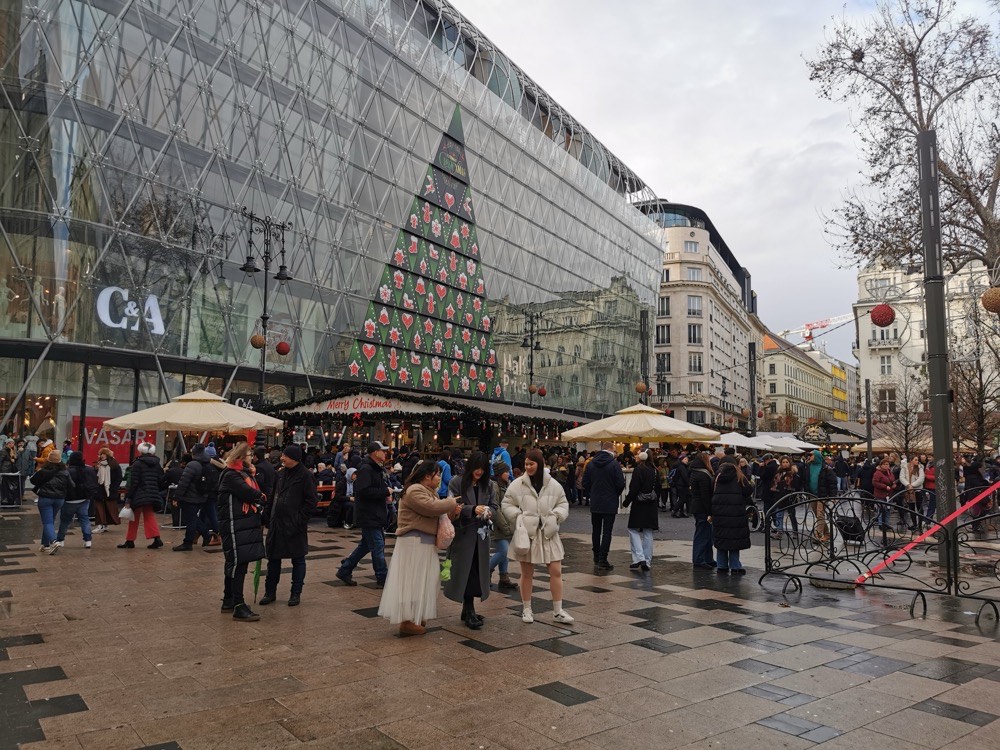
Budapest's main fair fills Vörösmarty tér, with a second market in front of St Stephen's Basilica a short walk away. Both are in the centre of Pest, with full coverage, and both get thick with people after dark, when the light shows on the basilica start. Forint is the currency; cards work at most stalls but not at every one.
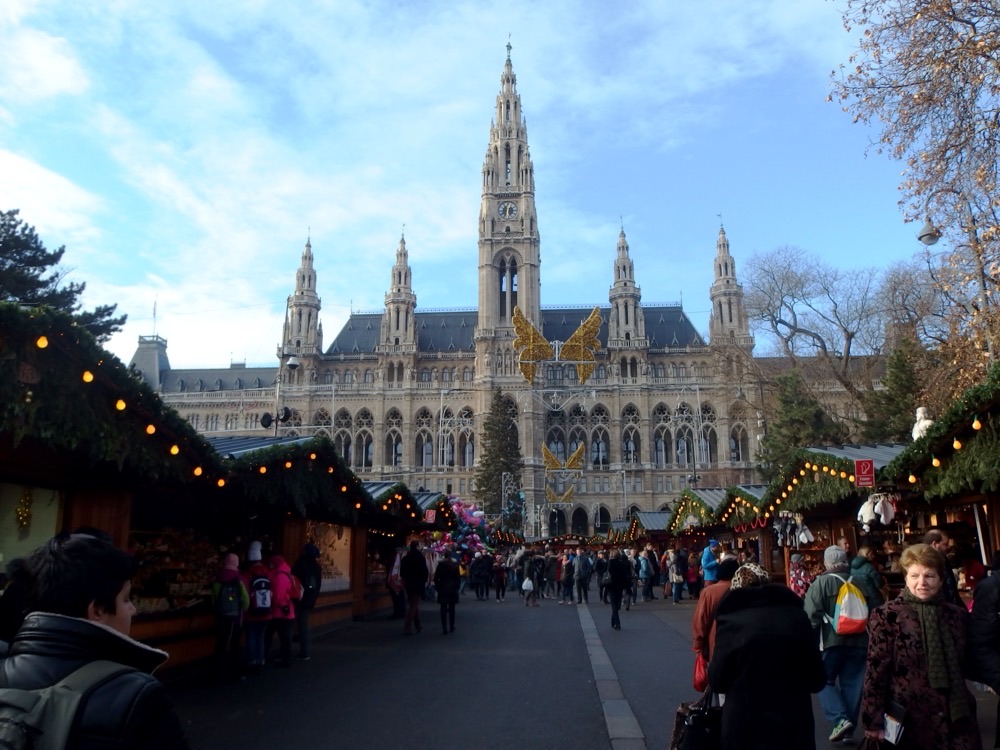
Vienna has a market on almost every square, but the one people mean is on Rathausplatz, in front of the city hall, with Schönbrunn, Spittelberg and the Belvedere close behind. For 2026, Vienna's tourist board gives 13 November to 26 December 2026 for Rathausplatz.
4 · Prague and Nuremberg
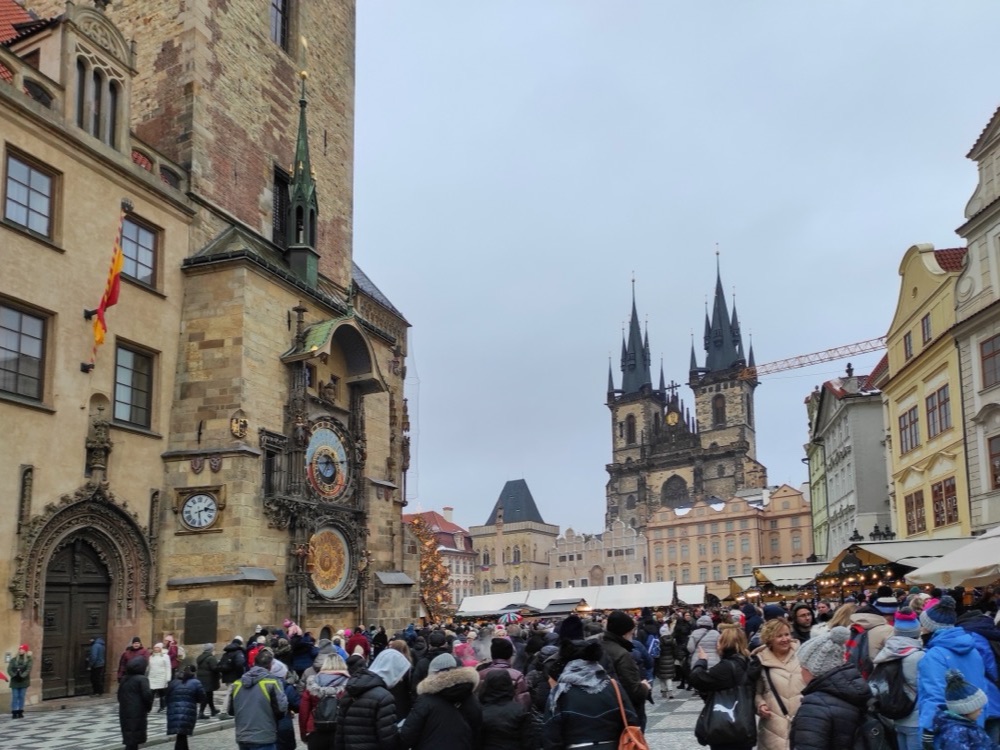
Prague's market fills the Old Town Square under the towers of the Týn church, with a second one on Wenceslas Square. The square is the city's busiest spot at the best of times, and in December the evening crowd round the tree is as dense as it gets. Czechia uses the koruna; cards are widely taken.
Nuremberg's Christkindlesmarkt on the Hauptmarkt is the one many people cross Europe for. For 2026 the city gives 27 November to 24 December 2026. The opening evening, when the Christkind reads the prologue from the balcony of the Frauenkirche above the square, is the most crowded hour of the season: go for the moment, not to send a video of it live.
5 · Strasbourg and Cologne
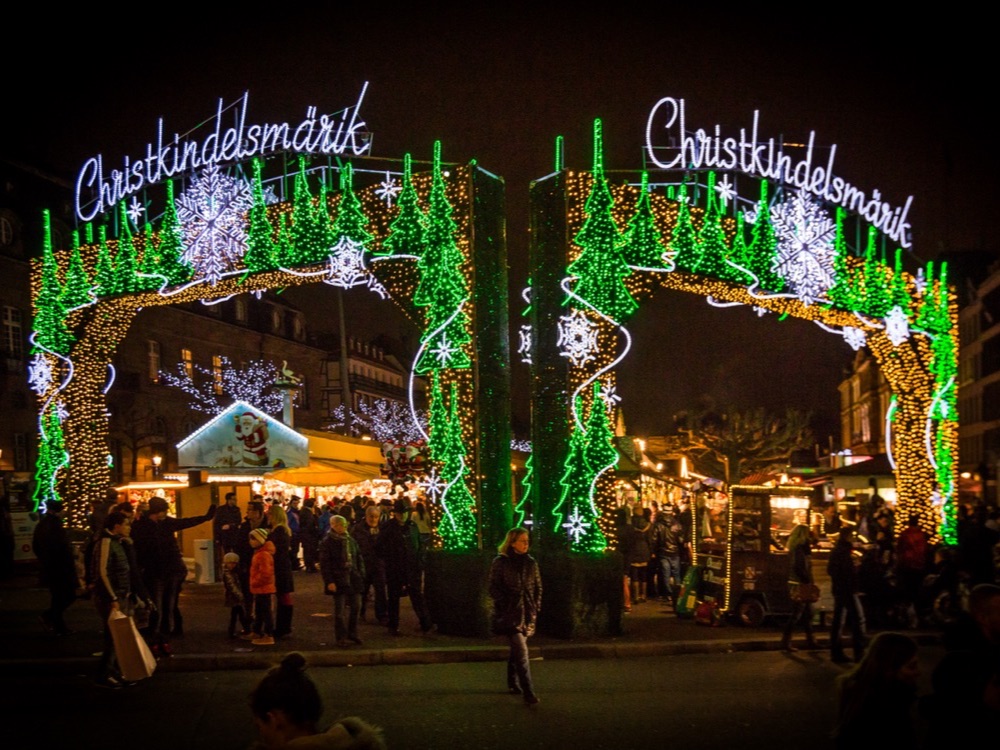
Strasbourg calls itself the capital of Christmas, and its Christkindelsmärik spreads over a dozen squares of the Grande Île, the old town on its island. In recent years the island has had security checks at its entrances during the market, which slow the walk in at busy times. Book the hotel early; the city fills.
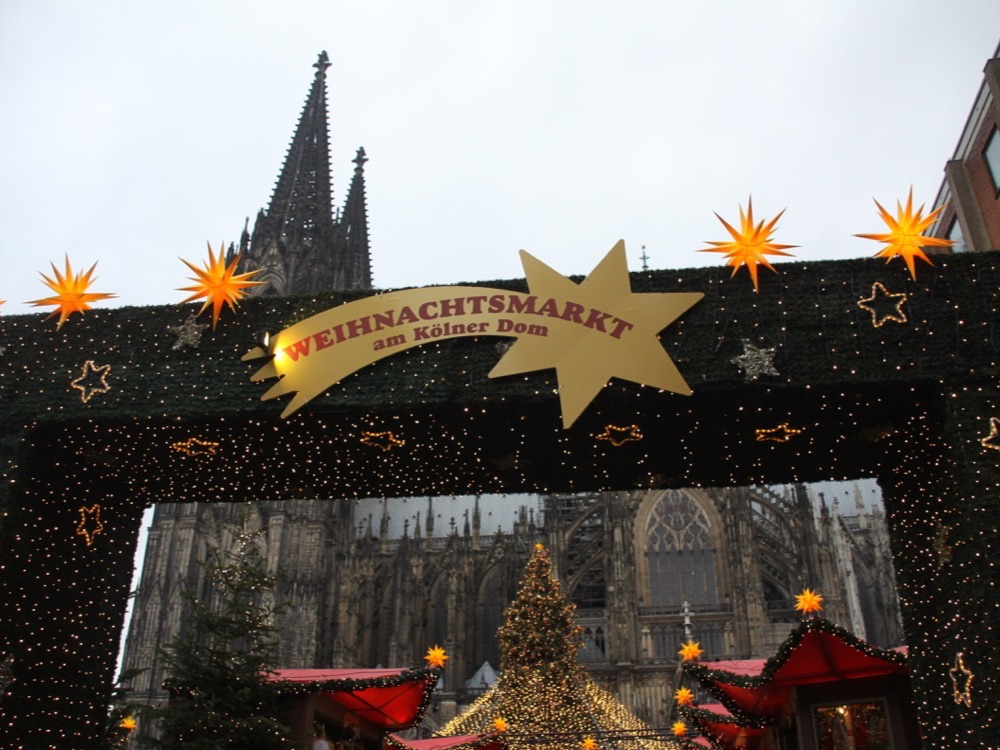
Cologne has several markets within walking distance of each other: the one below the cathedral on Roncalliplatz, the old town market, and the angels' market on Neumarkt. The cathedral market is next to the main station, which makes it the busiest of the lot at the end of a working day.
6 · Copenhagen and Tivoli
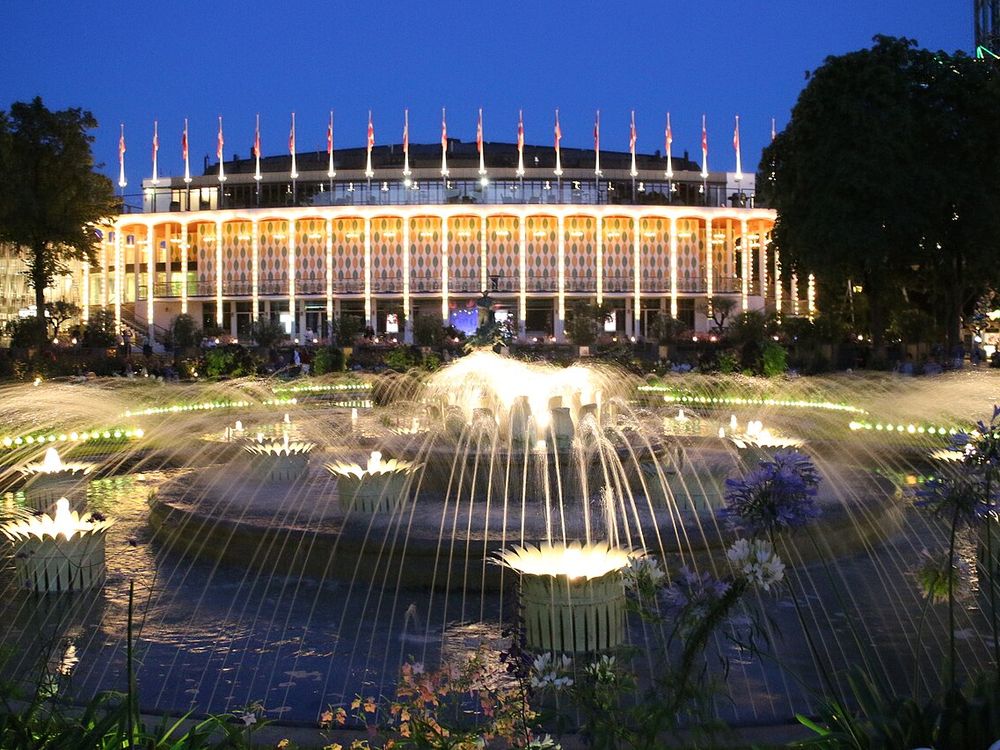
Copenhagen ends the loop. Tivoli, the old amusement park opposite the central station, turns into a Christmas garden, with stalls along Nyhavn and on the squares of the centre as well. Tivoli sells entry online, so the ticket is a QR code on your phone; add it to your wallet before you reach the gate. Denmark is close to cashless, so this is the stop where a card and a working phone matter most.
7 · The crowd signal problem
Every market on this list has the same weakness: thousands of people in one square, at the same hour, on the same few masts. From late afternoon at weekends the network in the square slows to a crawl. Messages queue, maps stall, and the photo of the stall you meant to share sits unsent until you walk away. That is congestion, not a fault with your eSIM.
- Agree a meeting point by name before you go in: the tree, the church door, a named stall. Not "by the mulled wine".
- Download the city map offline on hotel Wi-Fi, so walking out of a crowded square does not depend on data.
- Step a street away to send or load something; the signal comes back a block from the square.
- 5G helps. Where the market is covered by 5G, the network carries far more phones at once, and an unlimited plan at full speed uses it.
- Carry a power bank. Cold drains a battery faster, and a phone searching for signal in a crowd drains it faster still.
8 · Mugs, deposits and paying by card
At the German and Austrian markets, mulled wine comes in a ceramic mug with a deposit, Pfand in German, paid with the drink. Bring the mug back to any stall of the same market for the deposit, or keep it: each market, and often each year, has its own design, and plenty of people take one home. Many French markets, Strasbourg's among them, do the same with a deposit cup.
Card and phone payments are taken at more stalls every year, but not at all of them, and small stalls are the likeliest to want cash. Carry a little of the local money: euros in Austria, Germany and France, koruna in Prague, forint in Budapest. Paying by phone needs no data at the till, but your bank's security check on a new country sometimes does, so a phone that is online saves you a declined card at the stall.
9 · From the EU, the UK or the US
With an EU SIM, every country on this loop is inside the EU roaming rules, so your own allowance works at home prices up to your carrier's fair-use cap. An eSIM is for more data than the cap.
With a UK SIM, the EU rules have not applied since Brexit, and many UK carriers charge a daily roaming fee in Europe. Over a week of markets, that adds up. Our covers it the other way round.
With a US SIM, roaming is billed by the day or by the megabyte in every country here. A travel eSIM for data, with your own SIM kept for calls and texts, is the usual answer.
10 · What two weeks of unlimited data costs
Our priced the regional plans most people search for on the same day, 28 September 2026. Here is Ringo Light against the cheapest rival in each unlimited chart, with the length each one sells.
Swipe to compare →
Prices change; the comparison post has every brand and the full method.
11 · Which Ringo plan, and how to set it up
Ringo Light is our own data eSIM, sold to fund the full Ringo, one plan that works everywhere with your own number ported onto it. Installed once, next to your own SIM. Your number stays on your own line for calls and messages; the eSIM carries the data.
- The Europe plan, for the loop: 33 countries, unlimited data at full speed, 2 weeks for $22.99 or 30 days for $35.99, nothing that renews.
- A country plan, for one city: Hungary, Austria, Germany and France each have their own plan, 2 weeks for $14.99 or 30 days for $26.99; Czechia has its own, 2 weeks for $13.99 or 30 days for $26.99; Denmark has its own, 2 weeks for $16.99 or 30 days for $32.99.
- The Global plan, if you travel all winter: $49.99 a month for 133 countries, renewing until you cancel.
Install the eSIM on Wi-Fi before you leave, turn Data Roaming on for the eSIM line, and set it as your data line. The step-by-step is in our and .
The card below sells the Europe plan; the same plan is at ringoesim.com/europe.